Insert vs. Full-Frame Window Replacement
Free toolWindow Quote Comparison ToolPut up to four installer quotes side by side, line by line: cost per window, what each quote leaves out and what to ask.Compare my quotes →When you replace a window, you choose between two ways of installing it. An insert goes inside the frame you already have. A full-frame replacement takes the old frame out and puts a complete new window into the rough opening. The choice changes the scope of the job, what you pay for and how well the opening is sealed. For overall price data, see the window replacement cost hub.
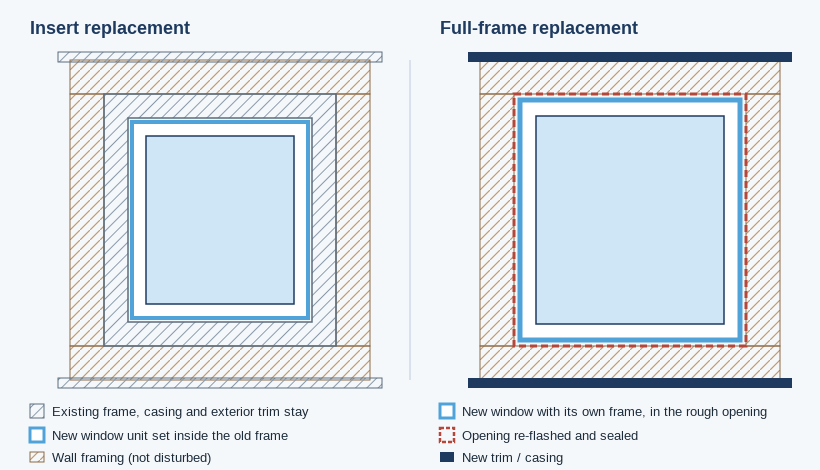
Insert vs. full-frame at a glance
| Insert (existing frame) | Full-frame | |
|---|---|---|
| What comes out | Old sash, side jambs and some trim; the original frame, casing and exterior trim stay[Efficient Windows Collaborative][U.S. DOE Building America Solution Center] | Sashes and the entire frame, back to the rough framing, often with interior and exterior casing and trim[U.S. DOE Building America Solution Center] |
| Glass area | Reduced, because a second frame sits inside the first[U.S. DOE Building America Solution Center] | Not reduced by an extra frame |
| Flashing and air sealing | The common practice installs in the existing frame without sealing the air gap or adding flashing[U.S. DOE Building America Solution Center] | The rough opening is lined with a waterproof membrane and pan flashing is installed[U.S. DOE Building America Solution Center][U.S. DOE Building America Solution Center] |
| Frame condition needed | Sill and frame in good condition, square and structurally sound[Efficient Windows Collaborative] | Works where the old frame is deteriorated[Efficient Windows Collaborative] |
| Siding and trim | Casing and trim can stay in place[Efficient Windows Collaborative] | Some siding usually has to be removed[U.S. DOE Building America Solution Center] |
| Disruption | Work can be done quickly with little disruption[DOE] | Typically a significant disruption[DOE] |
| Relative cost | Chosen to minimize disruption and cost[U.S. DOE Building America Solution Center] | High compared with other window retrofits[DOE] |
| Energy performance | Improves air leakage, conductance and solar gain over the old window[DOE] | The highest-performance option[U.S. DOE Building America Solution Center] |
| Historic homes | Changes appearance; typically not acceptable for historic zoned projects[U.S. DOE Building America Solution Center] | Not addressed by our sources; check local historic rules |
Key differences
What an insert involves
An insert window is custom-ordered to the size of the existing frame, though it doesn’t need as tight a tolerance as a replacement sash.[U.S. DOE Building America Solution Center] It is usually installed from inside: set on the sill, tilted up into the opening and pushed against the exterior casing. Outside, it should be caulked to the casing at the head and sides, with the sill left free to drain.[U.S. DOE Building America Solution Center] The old sash weights are abandoned, and the weight cavity should be air sealed and insulated.[U.S. DOE Building America Solution Center]
The condition of the sill is critical: cracked or rotting sills need to be replaced before an insert goes in.[U.S. DOE Building America Solution Center] And because an extra frame sits inside the old one, you lose some glass area, which can matter on windows that are already small.[U.S. DOE Building America Solution Center]
What full-frame replacement involves
A full-frame job removes the sashes and the whole frame, usually with the casing and trim.[U.S. DOE Building America Solution Center] The new rough opening is lined on all sides with a liquid-applied or self-adhered waterproof membrane that extends at least 4 inches onto the wall, and pan flashing goes in at the sill.[U.S. DOE Building America Solution Center][U.S. DOE Building America Solution Center] DOE’s checklist calls full-frame replacement the recommended option and asks for installation per the manufacturer’s specifications and ASTM E2112.[U.S. DOE Building America Solution Center]
A full-frame replacement gives the most control over window size, location and placement, and it is most commonly done as part of a more extensive renovation, for example together with new siding.[DOE][U.S. DOE Building America Solution Center]
Cost comparison
None of our sources puts a dollar figure on the difference between the two methods. What they say is qualitative: leaving the frame in place is the common way to minimize disruption and cost, and full-frame replacement is the most intrusive and expensive option.[U.S. DOE Building America Solution Center][U.S. DOE Building America Solution Center] NREL’s REMDB 2024 window costs don’t separate the two methods either.[NREL REMDB]
The extra cost of full-frame work comes from the extra scope: removing the frame, trim and some siding, lining and flashing the opening, and then new trim and siding patches. When you compare quotes, make sure each one states the method for every opening, or you’ll be comparing different jobs. Enter the quotes in our window quote comparison tool to see each one’s split between product, removal, installation and extras, and see installation labor costs for what each task involves.
Which is right for you? A decision tree
Work through these questions for each window:
- Is the old frame deteriorated, or is the sill cracked or rotting? If the frame is deteriorated, choose full-frame.[Efficient Windows Collaborative] A rotted sill must be replaced before an insert can go in.[U.S. DOE Building America Solution Center]
- Is the frame significantly out of square? If yes, full-frame.[Efficient Windows Collaborative]
- Do you need a larger opening, by choice or by code? If yes, full-frame.[Efficient Windows Collaborative]
- Is there a history of water getting in around the window? Windows are a common place for water infiltration,[U.S. DOE Building America Solution Center] and full-frame work lets the opening be lined and flashed. DOE’s Building America guidance says water intrusion must be dealt with as part of the work and gives suggestions for investigating its source.[DOE]
- Are you replacing siding or adding exterior insulation? Complete window replacement is most commonly done as part of a more extensive renovation.[U.S. DOE Building America Solution Center]
- Is the window already small, or does glass area matter to you? An insert reduces the vision area.[U.S. DOE Building America Solution Center]
- Do you want to keep the existing interior and exterior trim? If the frame and sill are sound and square, an insert works.[Efficient Windows Collaborative]
- Is the house in a historic district, or do you want to keep its original look? An insert is typically not acceptable for historic zoned projects.[U.S. DOE Building America Solution Center] Consider replacing only the sashes or repairing the windows.
Options short of a new window
- Sash replacement keeps the existing frame and replaces only the sashes, useful when you want to keep the original appearance. The sashes must be custom-built, and the work is workmanship-sensitive.[U.S. DOE Building America Solution Center]
- Repair and storm windows. If your windows are in good condition, DOE’s archived Energy Saver guidance says improving them may be the most cost-effective option.[DOE] DOE’s Energy Saver pages cited here have been removed from energy.gov; we cite the archived copies. Building America found exterior clear and low-E storm windows were the cost-optimized solutions for colder climates.[DOE]
Egress and code notes
For a bedroom window that serves as an emergency escape opening, the 2024 IRC model code exempts a replacement from the full egress size rules only if it is the manufacturer’s largest standard size that fits within the existing frame or rough opening, is the same operating style or one with an equal or larger opening, and isn’t part of a change of occupancy.[ICC] Because an insert sits inside the old frame, ask how its opening compares with the existing window before you order.
For a full checklist of what each quote should state, see how to read a window quote.
Sources
- U.S. Environmental Protection Agency, Code of Federal Regulations (eCFR, Title 40). 40 CFR Part 745, Subpart E—Residential Property Renovation (RRP Rule): §§ 745.80–745.84 (Purpose, Effective Dates, Applicability, Definitions, Information Distribution) and selected § 745.103 definitions (target housing). Accessed 2026-11-24.
- Efficient Windows Collaborative (efficientwindows.org, operated by NFRC). Insert Replacement Windows vs Full Window Replacement. Accessed 2026-11-24.
- U.S. DOE Building America Solution Center (Pacific Northwest National Laboratory; content by Building Science Corporation). Insert Replacement Window. Accessed 2026-11-24.
- U.S. DOE Building America Solution Center (Pacific Northwest National Laboratory; content by Building Science Corporation). Complete Window and Frame Replacement. Accessed 2026-11-24.
- U.S. DOE Building America Solution Center (Pacific Northwest National Laboratory). Window Replacement (Home Improvement Expert checklist). Accessed 2026-11-24.
- U.S. DOE Building America Solution Center (Pacific Northwest National Laboratory; content by Building Science Corporation). Window Sash Replacement. Accessed 2026-11-24.
- P. Baker, Building Science Corporation, for U.S. DOE Building America / NREL (December 2012; NREL subcontract KNDJ-0-40337-00). Measure Guideline: Wood Window Repair, Rehabilitation, and Replacement. Accessed 2026-11-24.
- U.S. Department of Energy (DOE), Building America (PNNL-SA-98660, September 2013). Building America Top Innovations 2013 Profile: Window Replacement, Rehabilitation, & Repair Guide. Accessed 2026-11-24.
- U.S. Department of Energy (DOE), Energy Saver. Update or Replace Windows. Accessed 2026-11-24.
- International Code Council (ICC). 2024 International Residential Code (IRC), Sections R319.5–R319.7.1: Replacement Windows for Emergency Escape and Rescue Openings, Existing Basements and Existing Openings. Accessed 2026-11-24.
- International Code Council (ICC). 2024 International Residential Code (IRC), Chapter 1, Section R105 Permits (R105.1 Required, R105.2 Work Exempt From Permit, R105.2.2 Repairs). Accessed 2026-11-24.
- U.S. Environmental Protection Agency (EPA). Renovation, Repair and Painting Program: Contractors. Accessed 2026-11-24.
- National Renewable Energy Laboratory (NREL; site now branded NLR) for the U.S. Department of Energy, via Open Energy Data Initiative (OEDI) submission 8336. National Residential Efficiency Measures Database (REMDB) 2024 — window, storm window and door (fenestration) cost data (2023$). Accessed 2026-11-24.