Double-Pane vs. Triple-Pane Windows
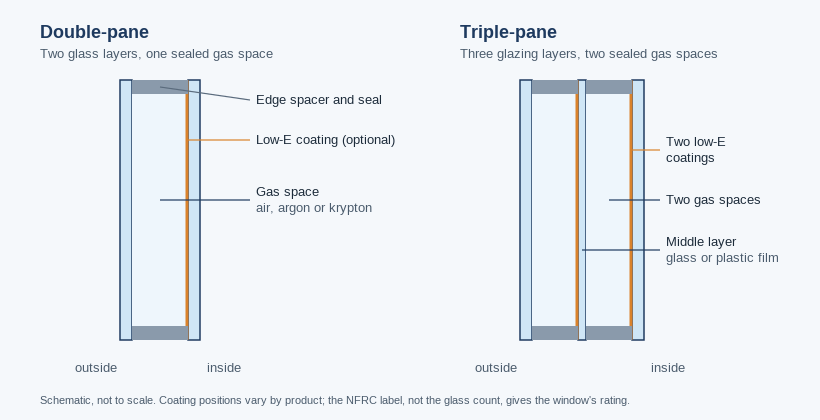
Free toolENERGY STAR Window CheckerFind your ENERGY STAR climate zone and check a window's U-factor and SHGC against the published criteria.Check my window →A double-pane window has two layers of glass around one sealed space; a triple-pane window adds a third layer and a second space. DOE’s archived Energy Saver guidance notes that virtually all new efficient buildings use double or triple glazing.[DOE] The real question is whether the third layer earns its cost in your climate.
Comparison matrix
Center-of-glass values describe the glass alone and are only for comparing glass types; frame choice can change whole-window performance drastically.[Efficient Windows Collaborative] Whole-window ranges are the Efficient Windows Collaborative’s generic ranges by frame type, not ratings for any product.
Notes on the matrix:
- The Efficient Windows Collaborative’s triple-pane page shows the same image for medium- and low-solar-gain center-of-glass values, so we list only the high- and low-gain figures.[Efficient Windows Collaborative]
Key differences
Insulation (U-factor)
Moving from single to double glazing cuts heat loss in half.[Efficient Windows Collaborative] Adding low-E to a double unit roughly halves the center-of-glass U-factor again (0.48 to about 0.25),[Efficient Windows Collaborative][Efficient Windows Collaborative] and a triple low-E unit brings it down to 0.15 to 0.16.[Efficient Windows Collaborative] The frame and spacer then decide how much of that reaches the whole-window rating. Low-conductance spacers are part of the Efficient Windows Collaborative’s triple-pane description,[Efficient Windows Collaborative] and warm-edge or non-metallic spacers cut heat flow and condensation at the edge compared with metal spacers.[Efficient Windows Collaborative]
Solar heat and daylight
A third layer lowers solar heat gain compared with double glazing with high-solar-gain low-E.[Efficient Windows Collaborative] It also lowers visible transmittance: the center-of-glass VT values above drop from 0.64–0.78 for double low-E to 0.51–0.69 for triple low-E.[Efficient Windows Collaborative][Efficient Windows Collaborative] A higher VT means more natural light.[National Fenestration Rating Council]
Gas fills
The space between layers is usually about 1/2 inch and is filled with argon or krypton; DOE’s archived page says argon is the most common because it is inexpensive and performs well, and krypton is used for thinner spaces of about ¼ inch and costs more.[DOE] The Efficient Windows Collaborative puts gas leakage at about 0.5% of the fill per year, leaving about 90% of original capacity after 20 years,[Efficient Windows Collaborative] and on its FAQ page says less than 1 percent per year for well-made units.[Efficient Windows Collaborative]
How each fits the ENERGY STAR zones
ENERGY STAR Version 7.0 (effective October 23, 2023) sets these window limits:[ENERGY STAR]
| Zone | U-factor | SHGC | What the matrix suggests |
|---|---|---|---|
| Northern | ≤ 0.22 (prescriptive); or exactly 0.23/0.24 (SHGC ≥ 0.35) or 0.25/0.26 (SHGC ≥ 0.40) | ≥ 0.17 (prescriptive) | Only the triple low-E range reaches ≤0.22 in the generic tables; the double low-E range for thermally improved frames (0.23-0.30) overlaps the equivalent-performance U-factors, which require a higher SHGC |
| North-Central | ≤ 0.25 | ≤ 0.40 | Double low-E in thermally improved frames can fall in range; check the label |
| South-Central | ≤ 0.28 | ≤ 0.23 | A low-SHGC product is the deciding factor more than pane count |
| Southern | ≤ 0.32 | ≤ 0.23 | Same: SHGC is the harder limit |
The right-hand column is our reading of generic ranges, not a rule. The equivalent-performance path applies only in the Northern zone.[ENERGY STAR] Whatever the glass, check each product’s NFRC label against your zone on the ENERGY STAR zones page.
Cost comparison
We found no current, dated, sourced price comparison of double- and triple-pane replacement windows. What we have:
- DOE Building America measure guideline (older report; costs in 2011 dollars). For its cold-climate modeling (numbered climate zones 4 and above, not ENERGY STAR zones) of an older benchmark house, it priced a double-glazed low-E ENERGY STAR window (U 0.30, SHGC 0.30) at $40.73 per square foot of window and a triple-glazed low-E window (U 0.20, SHGC 0.20) at $77.76.[DOE] In that analysis, exterior clear and low-E storm windows, not replacement windows, were the cost-optimized solutions for colder climates.[DOE] The prices are more than a decade old and per square foot, so use them only to compare the two options, not to budget.
- Efficient Windows Collaborative glazing page (undated). $385 to $850 per double-glazed window and $550 to $3,550 per triple-glazed window, with no source given. The page describes double glazing generally, not double low-E specifically.[Efficient Windows Collaborative] Treat both ranges as unsourced.
ENERGY STAR’s savings estimates don’t separate double from triple: they compare Version 7.0 windows with single-pane clear and double-pane clear baselines.[ENERGY STAR] If you already have double-pane clear windows, ENERGY STAR’s zone averages for replacing them run from $253 (6%) to $373 (8%) a year.[ENERGY STAR] Ask each installer to quote both glass options for the same window line, so the only difference is the glass.
Which is right for you?
- Are your current windows in good condition? DOE’s archived guidance says improving them may be the most cost-effective option,[DOE] and DOE’s archived Energy Saver hub page says low-E storm windows can save 12%–33% on heating and cooling depending on the existing window.[DOE] If yes, price storms or repairs before either replacement.
- Have you insulated and air-sealed? DOE’s older fact sheet (it still shows the superseded ENERGY STAR Version 5.0 zone map) advises doing that before replacing windows.[DOE]
- Which ENERGY STAR zone are you in?
- Northern: get quotes on triple-pane and on double-pane products that meet an equivalent-performance row; compare the labels and the price gap.
- North-Central: a double-pane low-E window that meets U ≤ 0.25 and SHGC ≤ 0.40 qualifies; triple is optional.
- South-Central or Southern: focus on SHGC ≤ 0.23. Triple-pane isn’t needed to meet the U-factor limits of 0.28 and 0.32.[ENERGY STAR]
- Is noise the main reason? The Efficient Windows Collaborative cites a Pacific Northwest National Laboratory case study saying thin triple-pane windows block more exterior noise, without figures.[Efficient Windows Collaborative] NFRC labels do not rate sound, so ask the manufacturer for tested sound ratings.
For coating choices within either option, see low-E glass. For the full checklist, return to choosing energy-efficient replacement windows.
Frequently asked questions
Do I need triple-pane windows to get ENERGY STAR in the Northern zone?
Not necessarily. The Northern prescriptive limit is U-factor 0.22 or lower with SHGC 0.17 or higher, but Version 7.0 also accepts a U-factor of exactly 0.23 or 0.24 with SHGC 0.35 or higher, or exactly 0.25 or 0.26 with SHGC 0.40 or higher. What counts is the window's NFRC rating, not the number of panes.
Are triple-pane windows worth it in a warm climate?
ENERGY STAR's Southern and South-Central U-factor limits are 0.32 and 0.28, so the extra insulation is not needed to qualify there; a low SHGC matters more. We found no source that models triple-pane payback in hot climates specifically.
Do triple-pane windows reduce noise?
The Efficient Windows Collaborative cites a Pacific Northwest National Laboratory case study saying thin triple-pane windows block more exterior noise, but it gives no measurements. NFRC energy labels do not rate sound.
Does the gas between the panes leak out?
Slowly. The Efficient Windows Collaborative gives a leakage rate of about 0.5% of the gas fill per year on one page and less than 1 percent per year on another, and says performance stays largely intact.
Sources
- Efficient Windows Collaborative (efficientwindows.org, operated by NFRC). Double-Glazed Windows: clear and tinted glass (properties). Accessed 2026-11-24.
- Efficient Windows Collaborative (efficientwindows.org, operated by NFRC). Double-Glazed Low-E Glass: high, medium and low solar gain (properties). Accessed 2026-11-24.
- Efficient Windows Collaborative (efficientwindows.org, operated by NFRC). Triple-Glazed Low-E Glass: high, medium and low solar gain (properties). Accessed 2026-11-24.
- Efficient Windows Collaborative (efficientwindows.org, operated by NFRC). Single-Glazed Windows: clear and tinted glass (properties). Accessed 2026-11-24.
- Efficient Windows Collaborative (efficientwindows.org, operated by NFRC). What is Window Glazing? (single vs double vs triple, with per-window costs). Accessed 2026-11-24.
- Efficient Windows Collaborative (efficientwindows.org, operated by NFRC). Gas Fills (argon and krypton). Accessed 2026-11-24.
- Efficient Windows Collaborative (efficientwindows.org, operated by NFRC). Efficient Windows Collaborative FAQ. Accessed 2026-11-24.
- Efficient Windows Collaborative (efficientwindows.org, operated by NFRC). Spacers (warm-edge and non-metallic spacer systems). Accessed 2026-11-24.
- ENERGY STAR (U.S. EPA). ENERGY STAR Program Requirements for Residential Windows, Doors, and Skylights — Eligibility Criteria Version 7.0. Accessed 2026-11-24.
- ENERGY STAR (U.S. EPA). Average Annual Energy Savings When Replacing Single Pane Clear / Double Pane Clear windows, by ENERGY STAR climate zone. Accessed 2026-11-24.
- U.S. Department of Energy (DOE), Energy Saver. Window Types and Technologies. Accessed 2026-11-24.
- U.S. Department of Energy (DOE), Energy Saver. Update or Replace Windows. Accessed 2026-11-24.
- U.S. Department of Energy (DOE), Energy Saver. Windows, Doors, and Skylights. Accessed 2026-11-24.
- U.S. Department of Energy (DOE), Energy Saver. Consumer Guide to Energy-Efficient Windows (fact sheet, DOE/EE-2468). Accessed 2026-11-24.
- P. Baker, Building Science Corporation, for U.S. DOE Building America / NREL (December 2012; NREL subcontract KNDJ-0-40337-00). Measure Guideline: Wood Window Repair, Rehabilitation, and Replacement. Accessed 2026-11-24.
- National Fenestration Rating Council (NFRC) via efficientwindows.org. Introduction to Window Ratings (NFRC label ratings explained). Accessed 2026-11-24.