U-Factor and SHGC, Explained
Free toolENERGY STAR Window CheckerFind your ENERGY STAR climate zone and check a window's U-factor and SHGC against the published criteria.Check my window →Every window certified by the National Fenestration Rating Council (NFRC) carries a temporary label with its energy ratings. NFRC describes itself as a nonprofit, public/private organization created by the window, door and skylight industry,[National Fenestration Rating Council] and its program evaluates U-factor, solar heat gain coefficient, visible transmittance, air leakage and condensation.[National Fenestration Rating Council] NFRC rates products; it does not set minimum performance levels or call windows good or bad. That is the role ENERGY STAR plays.[ENERGY STAR]
This page explains each number, shows where it sits on the label, and walks through one example.
The label at a glance
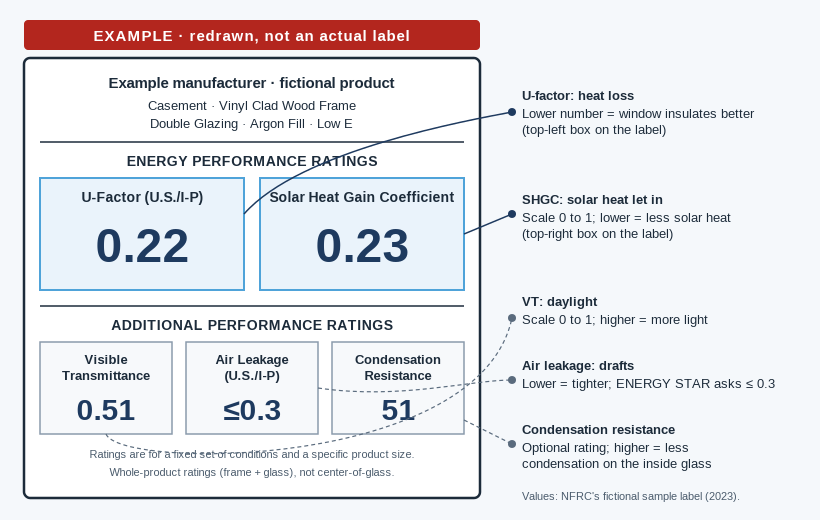
NFRC’s ratings guide puts U-factor in the top-left position and SHGC in the top-right position on all NFRC labels.[National Fenestration Rating Council] NFRC’s sample label groups those two under “Energy Performance Ratings” and lists visible transmittance, air leakage and condensation resistance below them as additional ratings.[National Fenestration Rating Council]
What each rating means
U-factor (heat loss)
DOE’s archived Energy Saver ratings page defines U-factor as the rate at which a window, door or skylight transmits non-solar heat flow.[DOE] ENERGY STAR’s specification gives the unit as Btu/h·ft²·°F.[ENERGY STAR] The lower the U-factor, the better the window insulates.[ENERGY STAR]
Two points that trip people up:
- U-factor is not R-value. NFRC notes that a lower U-factor is better, while a higher R-value indicates better performance.[National Fenestration Rating Council]
- Metric labels. To convert a U.S. (I-P) U-factor to SI units, multiply by 5.678.[Efficient Windows Collaborative]
Solar heat gain coefficient (SHGC)
SHGC is the fraction of solar radiation admitted through a window, either transmitted directly or absorbed and released as heat inside.[DOE] It runs from 0 to 1; the lower the number, the less solar heat the window transmits.[ENERGY STAR]
Lower is not automatically better. DOE explains that a high-SHGC product collects more solar heat in winter, a low-SHGC product cuts summer cooling loads, and the right value depends on your climate, orientation and shading.[DOE]
Visible transmittance (VT)
VT is the fraction of visible sunlight (380 to 720 nanometers, weighted by the eye’s sensitivity) that passes through the glazing; it is expressed between 0 and 1, and a higher VT means more daylight.[DOE] DOE also describes light-to-solar gain (LSG), the ratio of VT to SHGC; a higher LSG means more light for less heat, but it isn’t always provided.[DOE]
Air leakage (AL)
Air leakage is measured in cubic feet of air per minute through one square foot of window area; lower means tighter.[ENERGY STAR] ENERGY STAR Version 7.0 requires windows to be rated at or below 0.3 cfm/ft², shown as “≤ 0.3” on the NFRC label or through one of several listed certification labels.[ENERGY STAR] The 2024 International Residential Code (section N1102.5.3) sets the same 0.3 limit for windows, skylights and sliding glass doors, with an exception for site-built units; local jurisdictions adopt and amend different editions.[ICC] DOE adds that air leakage also depends on proper installation, which all ratings assume.[DOE]
Condensation resistance (CR)
CR rates how well a window resists moisture forming on its interior; a higher number means less condensation.[National Fenestration Rating Council] It is optional, so you may or may not see it on a label.[National Fenestration Rating Council] The Efficient Windows Collaborative advises a significantly higher CR rating in colder climates than might be necessary in warmer regions.[Efficient Windows Collaborative]
Published “typical ranges” do not agree
Several government and industry pages give a typical range for each rating. They differ, so treat them as rough context, not limits.
| Rating | ENERGY STAR | NFRC (efficientwindows.org) | DOE fact sheet (DOE/EE-2468, older) |
|---|---|---|---|
| U-factor | 0.25 to 1.25[ENERGY STAR] | 0.10 to 2.00[National Fenestration Rating Council] | 0.20 to 1.20[DOE] |
| SHGC | 0 to 1 scale; typically 0.25 to 0.80[ENERGY STAR] | 0.00 to 1.00[National Fenestration Rating Council] | 0 to 1[DOE] |
| Visible transmittance | 0 to 1 scale; generally 0.20 to 0.80[ENERGY STAR] | 0.00 to 1.00[National Fenestration Rating Council] | Not given |
| Condensation resistance | 0 to 100[ENERGY STAR] | 1 to 100[National Fenestration Rating Council] | Not given |
The NFRC guide also calls U-factor, SHGC and VT mandatory ratings and air leakage and condensation resistance optional.[National Fenestration Rating Council] Air leakage is optional for NFRC but required for ENERGY STAR certification.[ENERGY STAR]
Whole-window vs. center-of-glass numbers
NFRC U-factor ratings represent the entire window, including frame and spacer, while a U-factor quoted for “the glass” alone may not.[DOE] DOE’s archived advice is to compare whole-unit U-factors and SHGCs, because they reflect the whole product more accurately.[DOE] The frame matters: the sash and frame make up 10–30% of the window’s area.[Efficient Windows Collaborative]
Center-of-glass figures are useful for one thing: comparing glass packages to each other. The Efficient Windows Collaborative says they should not be used to compare total window products.[Efficient Windows Collaborative] If a brochure or quote shows a U-factor that looks unusually low, ask whether it is a whole-window NFRC rating.
Worked example: does the sample label meet ENERGY STAR?
ENERGY STAR Version 7.0, in effect since October 23, 2023, sets window limits by climate zone.[ENERGY STAR] Here is the example label (U-factor 0.22, SHGC 0.23)[National Fenestration Rating Council] checked against each zone’s prescriptive criteria:
| ENERGY STAR zone | Version 7.0 window criteria | Example: U 0.22 / SHGC 0.23 |
|---|---|---|
| Northern | U ≤ 0.22, SHGC ≥ 0.17[ENERGY STAR] | Meets both |
| North-Central | U ≤ 0.25, SHGC ≤ 0.40[ENERGY STAR] | Meets both |
| South-Central | U ≤ 0.28, SHGC ≤ 0.23[ENERGY STAR] | Meets both (SHGC exactly at the limit) |
| Southern | U ≤ 0.32, SHGC ≤ 0.23[ENERGY STAR] | Meets both (SHGC exactly at the limit) |
Air leakage also counts: the example shows ≤0.3, which is the Version 7.0 window requirement.[ENERGY STAR] This is a paper exercise on a fictional product. A real window is ENERGY STAR certified only if it is made by an ENERGY STAR partner, independently tested and certified through NFRC, and rated at or better than the criteria;[ENERGY STAR] zone-by-zone details and the Northern “equivalent performance” options are on ENERGY STAR climate zones for windows.
Which number to prioritize
DOE’s consumer fact sheet (DOE/EE-2468), an older publication that still shows the superseded ENERGY STAR Version 5.0 zone map, gives an orientation table:[DOE]
| Window faces | Cold climate | Warmer climate |
|---|---|---|
| North | Lowest U-factor you can afford | Low U-factor |
| South | Highest SHGC, lowest U-factor you can afford | Low SHGC (and lots of shade), low U-factor |
| East | Low SHGC (or shaded) | Low SHGC, low U-factor |
| West | Low SHGC (or shaded) | Low SHGC, low U-factor |
ENERGY STAR’s consumer page gives the same direction and adds that west-facing windows matter most for SHGC because they take summer sun in the warmest part of the day.[ENERGY STAR] For low-E coatings that set SHGC, see low-E glass.
Label tips when you buy
- Check the sticker is there. NFRC’s FAQ says a product without the sticker is not considered certified, and labels cannot be e-mailed or sent separately.[National Fenestration Rating Council]
- Remember what the label does not cover. NFRC ratings do not take installation into account.[National Fenestration Rating Council] They are determined for fixed conditions and a specific product size.[National Fenestration Rating Council]
- Keep the label. ENERGY STAR suggests saving the ENERGY STAR and NFRC labels as documentation,[ENERGY STAR] and the Efficient Windows Collaborative notes the NFRC label becomes documentation you may need for utility, state or local rebates or incentives.[Efficient Windows Collaborative]
- Compare the same kind of number. Line up whole-window U-factor and SHGC from each quote, not marketing figures for the glass.[DOE]
To test your own label values against your zone, use the ENERGY STAR window checker. For the bigger buying picture, start at choosing energy-efficient replacement windows.
Frequently asked questions
Is a lower U-factor always better?
For heat loss, yes: ENERGY STAR, NFRC and DOE each say a lower U-factor means less heat loss or better insulation. It is not the whole story, because SHGC, air leakage and installation also affect comfort and energy use.
Should SHGC be high or low?
It depends on climate and orientation. DOE's archived Energy Saver page explains that a high SHGC collects more solar heat in winter while a low SHGC blocks summer heat gain. ENERGY STAR's Version 7.0 criteria cap SHGC in the North-Central, South-Central and Southern zones and set a minimum SHGC in the Northern zone.
How is U-factor different from R-value?
They run in opposite directions. NFRC's ratings guide notes that a lower U-factor is better while a higher R-value indicates better performance. Window labels use U-factor.
What if my new window has no NFRC sticker?
NFRC's FAQ says a product without the sticker is not considered a certified window, and labels cannot be sent separately from the window. Ask the dealer before installation.
Are center-of-glass numbers the same as label numbers?
No. NFRC label U-factors cover the entire window, including frame and spacer, while center-of-glass values describe the glass alone. DOE's archived Energy Saver advice is to compare whole-unit ratings.
Sources
- ENERGY STAR (U.S. EPA). Windows, Doors and Skylights Key Product Criteria (What makes it ENERGY STAR?). Accessed 2026-11-24.
- National Fenestration Rating Council (NFRC) via efficientwindows.org. Introduction to Window Ratings (NFRC label ratings explained). Accessed 2026-11-24.
- National Fenestration Rating Council (NFRC). NFRC sample label with Condensation Resistance (NFRC_Label_w_CR). Accessed 2026-11-24.
- National Fenestration Rating Council (NFRC) via efficientwindows.org. What is the NFRC? (NFRC label overview). Accessed 2026-11-24.
- National Fenestration Rating Council (NFRC). Frequently Asked Questions (windows, doors, skylights). Accessed 2026-11-24.
- National Fenestration Rating Council (NFRC). Residential Product Certification. Accessed 2026-11-24.
- ENERGY STAR (U.S. EPA). Independently Tested and Certified Energy Performance (NFRC label ratings explained). Accessed 2026-11-24.
- ENERGY STAR (U.S. EPA). ENERGY STAR Program Requirements for Residential Windows, Doors, and Skylights — Eligibility Criteria Version 7.0. Accessed 2026-11-24.
- ENERGY STAR (U.S. EPA). Residential Windows, Doors, & Skylights (ENERGY STAR consumer page). Accessed 2026-11-24.
- U.S. Department of Energy (DOE), Energy Saver. Energy Performance Ratings for Windows, Doors, and Skylights. Accessed 2026-11-24.
- U.S. Department of Energy (DOE), Energy Saver. Update or Replace Windows. Accessed 2026-11-24.
- U.S. Department of Energy (DOE), Energy Saver. Consumer Guide to Energy-Efficient Windows (fact sheet, DOE/EE-2468). Accessed 2026-11-24.
- Efficient Windows Collaborative (efficientwindows.org, operated by NFRC). Single-Glazed Windows: clear and tinted glass (properties). Accessed 2026-11-24.
- Efficient Windows Collaborative (efficientwindows.org, operated by NFRC). Window Frames (frame material overview). Accessed 2026-11-24.
- Efficient Windows Collaborative (efficientwindows.org, operated by NFRC). Efficient Windows Collaborative FAQ. Accessed 2026-11-24.
- Efficient Windows Collaborative (efficientwindows.org, operated by NFRC). How to Cut Condensation? (condensation resistance). Accessed 2026-11-24.
- Efficient Windows Collaborative (efficientwindows.org, operated by NFRC). Choosing Windows (five steps). Accessed 2026-11-24.
- International Code Council (ICC). 2024 International Residential Code (IRC), Chapter 11 [RE] Energy Efficiency — Table N1102.1.2 (R402.1.2) Fenestration U-Factor and SHGC by Climate Zone, N1102.4 Fenestration, N1102.5.3 Fenestration Air Leakage, N1102.6 Maximum Fenestration U-Factor and SHGC. Accessed 2026-11-24.